Showing posts with label good eats. Show all posts

Cool foods to eat this summer


Excessive heat, for instance, can seriously upset the body, causing irritability, sleep problems, exhaustion and lack of concentration, among other things.

But food and drink have a big part to play in helping your body keep cool and healthy during the heat. Here's what to stock in your fridge to survive the sizzling temperatures ...


Fruit with yoghurt: is an ideal combination for breakfast in really hot weather. Fruit, which has a high water content, will help maintain your body fluid, which will be lost more rapidly through sweat, the body's mechanism for cooling down in the heat.
Bio yoghurts can promote friendly gut bacteria, such as Lactobacillus acidophilus. This protects against food poisoning, cases of which dramatically increase during hot temperatures when it is difficult to keep food fresh.

Vegetables: "It is vital to maintain your body's water levels in the heat, not just by drinking fluids, but also choosing foods that contain a lot of water," says Catherine Collins, chief dietician at St George's Hospital, Tooting.
"Vegetables are obvious choices as they contain lots of fluid. Avoid boiling or steaming them for too long, as this depletes them of their water and nutrient content."

A baked potato or pasta salad: carbohydrate-rich foods can help to combat heat exhaustion. Dr Wendy Doyle, from the British Dietetic Association, recommends eating regular small, starchy carbohydrate snacks during the day, such as pitta bread, to keep your body's blood-sugar and energy levels even.
Other ideal carbohydrate foods include baked beans, rice, fruit, yoghurt and milk. And she advises us to eat spicy foods: "Although this may be the last thing you fancy in hot weather, curries and chillies can stimulate heat receptors in the mouth, enhance circulation and cause sweating, which cools the body down."

Tzatziki: the Greek dip combines yoghurt and cucumber, which has a water content of about 96.4 per cent.

Watercress: a rich source of minerals, including iron, which some nutritionists believe can be depleted through perspiration. A lack of iron can cause us to feel tired and lethargic. Other foods which contain this mineral include lean meat, fruit and green vegetables.

Mint: although mint does not cool the whole body down it is cooling on the tongue and therefore tastes refreshing in hot weather.

Onions: especially red ones contain
a chemical called quercetin which is believed to have an anti-histamine effect. Histamine is the irritant that causes heat rashes and adverse reactions to insect bites and stings, so eating onions daily may help to ease these summer complaints.

Marinated meats on barbecues: marinades reduce the levels of cancer-risk chemicals being produced when meats are charcoaled black. Ms Collins explains: "Scientists aren't sure why this is, but they believe it could be because the ingredients in most common marinades are high in cancer fighting antioxidants.î These include vinegar, citrus juices, herbs, spices and olive oil.

Bananas: a rich source of potassium, which helps to regulate body fluid lost through excessive sweating. Other potassium-rich foods are green vegetables, baked beans, dried fruit and cereal.

Melons: Dr Doyle says that fruit is important in hot weather to bump up your fluid intake, and melons contain more than 90 per cent water.


Malaysian Food Delights

It’s not the most talked about country, but when it comes to dining, there is probably no other place with such an incredible – and mouthwatering – array of food choices in the whole region than Malaysia.
Saucy chicken cuts, vegetarian food, a plethora of rice dishes, all sorts of steamed and barbequed fish, and a paradise of noodles.  It is probably because of such an intricate variety – obvious reflection of the country’s diverse ethnic mélange – that most visitors may have a problem choosing what they like best, or what they should try first.
To help you get the best out of your Malaysian food experience, here are 10 of the most authentic, delicious, and readily available dishes you may find on offer at any Malaysian street corner and restaurant. Moreover, they are good to suit all sorts of travel budgets. Be advised, though: you will need to be comfortable around spicy food in order to fully appreciate the best that Malaysian cuisine has to offer. To help you, I have indicated a 1 to 5 point spice grading for each item.
There is definitely much more to be learned about Malaysian food. However, after reading the following 10 suggestions, you will be able to order confidently your favorite delicacies without making the locals queuing behind you go “gila”…

1: Nasi lemak


Spice-o-meter: 3 out of 5
If there is a quintessential Malay staple rice dish, that is nasi lemak. Literally meaning “butter rice,” it is a simple white rice dish spruced up with almonds, dried anchovies, cucumber, boiled eggs, and spicy sambal sauce. You may find it in two different varieties: the simple street version packed in a banana leaf and conceived to be swiftly consumed sitting on a stool at a street stall, or the more “up market” kind served in restaurants on a plate. The difference usually comes with pricing, where a street side nasi lemak may cost you as low as 1 ringgit (around $0.33USD), while the one served on a plate may reach up to 6 ringgit ($2), according to the quantity of side choices that are offered along with the rice. To many, this is the essential dish representing the Malay Muslim majority and is not to be confused with Nasi goreng, or better, the different fried rice variety.

2: Satay


Spice-o-meter: 1 out of 5

This is barbeque, Malaysian style.  Feast on different chicken, lamb, or beef mini skewers perfectly roasted on a fire grill and served together with a sweet-sour crumbled peanut sauce.
The most daring may try the cow intestines, definitely a bit more chewy than the others, but totally enjoyable. You may also try the squid satay, which is generally served at most street stalls lining the Malaysian coastline. The specialty of satay is the mildly spicy peanut sauce served with your skewers.  By skipping the dip, you would not really savor satay’s unique flavor. A perfect companionship for those long-lasting Malaysian sunsets spent sitting at a street stall or relaxing at a beach’s esplanade, preferably with Tiger beer in hand.

3: Char koay teow

Spice-o-meter: 2 out of 5
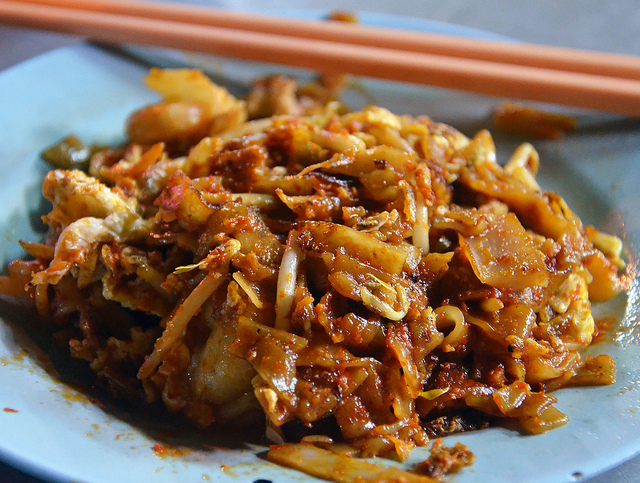
This kind of fried noodles is typically Malaysian: flat, wide noodles are served together with fried egg, green lettuce, bean sprouts, and seafood.  This constitutes one of the country’s not-to-miss dishes. It comes in a Chinese and Malay version – the former being drier and the latter heavier on prawn and minced seafood. Char koay teow differs in each region, and different cities provide a slightly different mix of the ingredients, with each one adding local flavor. One of the most delicious and famous is definitely Penang island’s, where you can literally find char koay teow anywhere you look for food.

4-Hokkien mee

Spice-o-meter: 4 out of 5
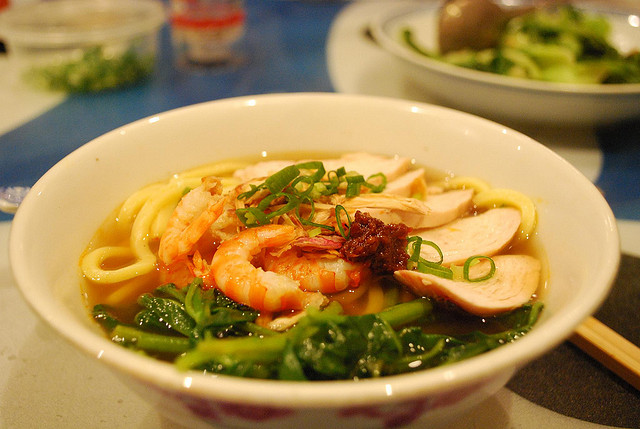
Typical noodle staple dish of the Malaysian Chinese community, hokkien mee is a hot bowl of steamy noodles cooked with prawn, boiled egg, chilies, and spices. To me, this is possibly the best, most representative noodle dish in the country. You can choose white, yellow, or glass noodles, or a mix of the three, to slightly modify the taste and the way your noodles will absorb the spicy broth. Make sure you have a drink and some tissues on you, as hokkien mee can literally “open up” your sinuses! Hokkien mee is recommended for hot nights and monsoon days. Again, Penang has some of the best in the country.